*Memory Matrix
Writings, notes, and data
Pages
Categories
- America Notes (1)
- Book notes (5)
- Computing Notes (58)
- Errata Notes (2)
- Gaming Note (3)
- Garden Notes (1)
- History notes (4)
- Literature Notes (2)
- Social Science notes (11)
- Spiritual notes (9)
Blogroll
- <toby> Mackenzie's site
- A Common IT Man's Blog
- a3nm's blog
- Alexander Zeitler
- American Thinker
- Anant Shrivastava
- Barter Is Evil
- Card Catalog
- Chris Meller
- Chronicles Magazine
- Consumer Rights Wiki
- Curmudgucation
- Debunking Skeptics
- Elijan Mastnak
- Fireborn
- Global Geopolitics
- Gwern Branwen
- Issues & Insights
- Joe Wingbermuehle
- Julia Evans
- Kailash Nadh
- Laidback Gardener
- Las Ultimas Noticias
- Laura Aboli channel
- Lew Rockwell
- Matt Mahoney's Home Page
- Menno Simons.net
- Michael Eriksson
- Natural News
- Neocities
- Norman Geisler
- Pavel Rojtberg
- Piekniewski's blog
- Prophecy Update
- Psuedo Singleton / Justin
- Ray Peat
- Reminiscence of the Future
- Richard Brath
- Schneier on Security
- Simon Says
- Straight Line Logic
- The Cyanide Hole
- The Divinely Inspired Scriptures
- The Last Refuge
- The Occidental Observer
- The Prophecy of Jacob and Esau
- The Skeptical Doctor
- The Somnolescent Archives
- The Text of the Gospels
- The Toll
- Turbulent Times
- Unveiling the Apocalypse: Prophecy in Catholic Tradition
- What is Truth?
Books
- A Defence of the True Church Called Quaker (John Cook, 1659)
- Brenton Septuagint Translation
- English Revised Version (1885)
- Geneva 1590 (without Apocrypha)
- Holy Bible – Geneva 1579
- King James' Version
- Patriarchal Text (1904)
- The Holy Bible translated by Robert Young (1863)
- Westminster Leningrad Codex (HTML)
- Westminster Leningrad Codex (PDF)
Data
Gaming - Ark
Gaming - Minecraft
News
Tools
- Ahuka Communications
- AWMACH Bible Library
- Baidu (Boolean Search capability!)
- Bible Research
- Biblical Studies Commons
- Bob is the Oil Guy Forums
- D3 Examples
- D3.js
- D3.js Graph Gallery
- Debian Handbook
- DeskDr.com
- DEV Community
- Dissertations from Andrews U.
- Dot Net Perls
- EWG's Food Scores
- Fallacies
- Filmot
- Greek Word Study Tool
- Hugging Face
- Introduction to Logic
- Level 1 Techs Forums
- Linux Reviews
- Logical Fallacies
- Marginalia (old address)
- Marginalia Search
- Mechanical Translation Project
- medRxiv
- Mojeek
- NetworksDB IP Intelligence
- Online Etymology Dictionary
- Open Culture
- OpenScriptures Hebrew Bible
- Post.Bytes
- Start Page
- Tanach.us (Revision of WLC)
- Windows Tip of the Day
- Word Reference
- Zeitgeist Reviews
- Zettelkasten Forum
- Zettelkasten Method
Web 1.0
Tags
- 7Zip
- AI
- Aider
- AlmaLinux
- Alphabet
- Amos
- Anthropic
- apologetics
- AppImage
- Apple
- apt
- arbitration
- archiving
- Backup
- Baptist
- Bash
- Batch
- Bible
- Books
- bookworm
- bullseye
- California
- castle
- Caution
- CentOS
- Changelog
- children
- Chromium
- Claude
- color
- Colorado
- commentary
- copyright
- counties
- Cron
- database
- Debian
- Department of Energy
- Devuan
- digital ID
- digital sovereignty
- discrimination
- economics
- egregore
- ERV
- Extensions
- Fedora
- filter bubble
- Firefox
- floccus
- Ford
- freedom
- futurism
- garden
- Genesis
- genetics
- Geneva
- gentiles
- Georgia
- Ghostscript
- GM
- GPL
- Greek
- Grub
- GTK
- Health
- Hebrew
- history
- HP
- HPLIP
- Hydrogen
- hypocrisy
- hypothesis
- Hyundai
- IceWM
- iftop
- Illinois
- iptraf
- Java
- Jeremiah
- Jeremias
- Joplin
- Kafka
- Kentucky
- king
- KJV
- Labor
- language
- Leningrad
- Library
- LibreWolf
- Linux
- Logseq
- Luke
- LXQT
- majority text
- MariaDB
- marketing
- Massachusetts
- Matthew
- Michigan
- Microsoft
- Minecraft
- Mistral
- Mojeek
- Montana
- Mozilla
- MySQL
- Nano
- networking
- New Jersey
- Nextcloud
- Nikola
- North Carolina
- North Dakota
- ntp
- Obsidian
- Ollama
- open source
- Oracle Linux
- Organization
- paired comparision
- Partitions
- php
- Picom
- preterism
- Price's law
- privacy
- programming
- prophecy
- Python
- QOwnNote
- QPDF
- R
- RAID
- rstudio
- r^2
- SELinux
- serfdom
- sharecropping
- SSH
- Stata
- Stephanus
- swap
- systemd
- Tennessee
- textus receptus
- Thunderbird
- time series analysis
- Tischendorf
- treasuries
- tree
- Trilium
- uMatrix
- Vermont
- VirtualBox
- Virtualization
- Vivaldi
- Volvo
- Westcott & Hort
- Windows
- wisdom
- WordPress
- WSL
- X11
- XFCE
- yacy
- z240302wa
- z260205wa
- z260518wa
- z260518wb
- z260519wa
- z260521wa
- z260525wa
- z260625wa
- z260625wb
- Zen Burn
- Zettelkästen
- Zettlr
- Zotero
- ἔθνεσιν
- ἔθνος
- θεός
- ΙΕΡΕΜΙΑΣ
Check the source text
One problem that a person studying the Bible will encounter rears its ugly head in this example. That is the false word. In this case, the word is gentiles. The screenshot below of a website shows a Greek text and an English text of Amos 9:12. The English text presented uses the word gentiles. The Greek word highlighted on the right is ἔθνος. The word means something like a province, tribe, class of men, caste, trade association, guild, or race. The key component being that is an aggregate body. The plural of it would then be something like nations or peoples. E.g. the peoples of the Levant, or the nations of the Orient. It refers to flocks of bees, flies, and birds.
The word gentiles is a Latin word that become an egregore.
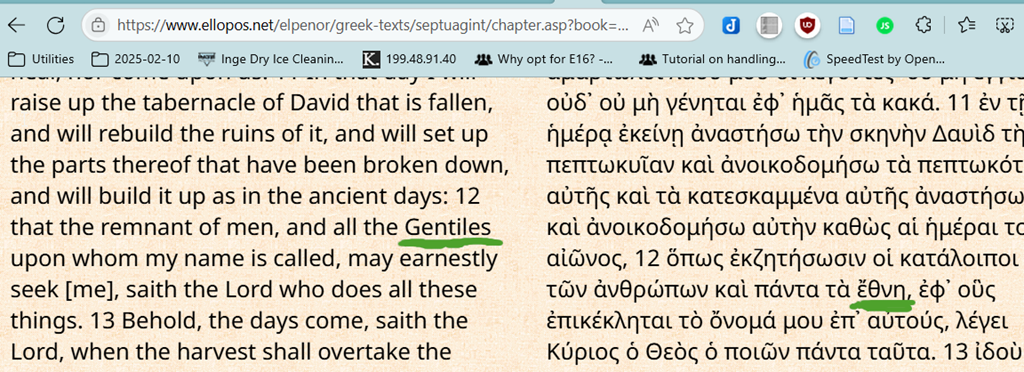
Figure a [1]
The following example (emphasis mine) shows another difference where ethnos does not mean others in a binary ideological sense of the ideologue’s self and the abstracted other. It means preached unto the tribes, nations, or groups of people. The following is from 1st Timothy, Chapter 3.
And without controversy great is the mystery of godliness: God was manifest in the flesh, justified in the Spirit, seen of angels, preached unto the Gentiles, believed on in the world, received up into glory.
καὶ ὁμολογουμένως μέγα ἐστὶ τὸ τῆς εὐσεβείας μυστήριον· Θεὸς ἐφανερώθη ἐν σαρκί, ἐδικαιώθη ἐν Πνεύματι, ὤφθη ἀγγέλοις, ἐκηρύχθη ἐν ἔθνεσιν, ἐπιστεύθη ἐν κόσμῳ, ἀνελήφθη ἐν δόξῃ. [2]
The thought form that develops from the cultic use implies that Jesus was preached to a solitary outgroup as opposed to a ideology based ingroup. It posits the existence of two groups only when the meaning of the word covers multiple groups rather than an ideological binary. ἔθνος appears in the Wiktionary with a useful analysis.
The 1885 English Revised version uses the word nations.
And without controversy great is the mystery of godliness; He who was manifested in the flesh, justified in the spirit, seen of angels, preached among the nations, believed on in the world, received up in glory. [3]
This is from the Geneva Bible.

And without controuerfie , great is the myſterie of godlines. which is, God is manifetted in the flelly, tuttified in the Spirit, feene of Angels, preached unto the Gentiles, beleeued on in the Would, and receined up in glozie [4]
Young’s Literal Translation of 1863 renders the verse beautifully. While looking at the verse is notable to see the phrase "seen by messengers" as opposed to "seen by angels" which appears in many versions. Angels is another word that became an egregore but that is a topic for another memo.
and, confessedly, great is the mystery of godliness, God was manifested in flesh, declared righteous in spirit, seen by messengers, preached among nations, believed on in the world, taken up in glory. [5]
All of these versions add punction that is not present in the original scriptures. The original scriptures contain no commas and semi-colons. The Geneva Bible contains an incredible amount of commentary in the margin.
The Interlinear from George Ricker Berry, PH.D. includes many punctuation marks that do not appear on images of original manuscripts. They appear even in the Greek portion of his interlinear text. The following shows 1 Timothy, Chapter 3. The word the shows the placement in the later work where the same word appears in brackets to indicate the modern translator/scribe added it to the text. Three versions appear below. The top version is the one in the authorized version and the second is the English translation that appears under the words in Greek in this book.
And without controversy great is the mystery of godliness: God was manifest in the flesh, justified in the Spirit, seen of angels, preached unto the Gentiles, believed on in the world, received up into glory.
καὶ ὁμολογουμένως μέγα ἐστὶν τὸ τῆς εὐσεβείας μυστήριον θεός" ἐφανερώθη ἐν σαρκί, ἐδικαιώθη ἐν πνεύματι, ὤφθη ἀγγέλοις,. ἐκηρύχθη ἐν ἔθνεσιν, ἐπιστεύθη ἐν κόσμῳ, ἀνελήφθη ἐν δόξῃ.
And confessedly great is the of piety mystery god was manifested in flesh was justified in the spirit was seen by angels was proclaimed among the nations was believed on in the world was received up in glory [6]
The Oxford University Press’s version incorporating the Scrivener text of 1881 has the following on page 909.
ἑδραίωμα τῆς ἀληθείας καὶ ὁμολογουμένως μέγα ἐστὶ τὸ τῆς εὐσεβείας μυστήριον ὃς ἐφανερώθη ἐν σαρκί ἐδικαιώθη ἐν πνεύματι ὤφθη ἀγγελοις ἐκηρύχθη ἐν ἔθνεσιν ἐπιστεύθη ἐν κόσμῳ ἀνελήφθη ἐν δόξῃ [7]
And without controversy great is the mystery of godliness; He who was manifested in the flesh, justified in the spirit, seen of angels, preached among the nations, believed on in the world, received up in glory. [3]
And without controversy great is the mystery of godliness: God was manifest in the flesh, justified in the Spirit, seen of angels, preached unto the Gentiles, believed on in the world, received up into glory. [8]
1 I Saw the Lord Standing on the Altar: And He Said, Smite the Mercy-Seat, and … AMOS / ΑΜΩΣ9 – Bilingual Septuagint.” Accessed July 6, 2025. https://www.ellopos.net/elpenor/greek-texts/septuagint/chapter.asp?book=32&page=9.
2. "Ch 3 – To Timothy 1 – The New Testament.” Accessed July 12, 2025. https://www.ellopos.net/elpenor/greek-texts/new-testament/timothy_1/3.asp.
3. “Revised Version with Apocrypha (1895) 1 Timothy 3.” Accessed July 12, 2025. http://memorymatrix.cloud/rv/1TI03.htm.
4. http://memorymatrix.cloud/wp-content/uploads/2024/10/Holy-Bible-Geneva-Bible-1579.pdf#page=1181
7. The_New_Testament_of_Our_Lord_and_Saviour-Oxford-University-Press-1896.pdf#page=909
The king as god in the KJV
A discrepancy appears in the King James’ Version and other Masoretic Text bibles relative to the Septuagint version in the book of Jeremiah (ΙΕΡΕΜΙΑΣ). The Masoretic Text derived bibles equate the king with the deity. The term LORD of hosts supposedly represents a place in the original language texts where the divine name appears. That may not always be the case. There is a popular online Bible translation which lists the papyrus from which it derives each translation. One can check the papyrus for the divine name in places where that translation says LORD and there is no instance of the divine name on the original document. For this particular instance, the difference appears in these three quotations.
1885 RV: Moab is laid waste, and they are gone up into her cities; and his chosen young men are gone down to the slaughter, saith the King, whose name is the LORD of hosts. [1]
The King James’ Version is similar to the English Revised Version.
KJV: Moab is spoiled, and gone up out of her cities, and his chosen young men are gone down to the slaughter, saith the King, whose name is the LORD of hosts. [2]
The Septuagint version does not equate the king with the deity.
LXX: 16. Moab is ruined, even his city, and his choice young men have gone down to slaughter. 16 The day of Moab is near at hand, and his iniquity moves swiftly to vengeance.[3]
This question particularly interests me. Perhaps twenty years or more ago, an exposition on the subject of the old testament included someone explaining that old testament religion was an abstraction of the king, and essentially a form of worshipping the king as a military commander. That description really inspired me to research and study more.
Amos 4:13 negates the concept of a king occupying the conceptual space of the deity as does the three angels’ message in the book of Revelation.
1. Revised Version with Apocrypha (1895) Jeremiah 48
2. King James Version + Apocrypha Jeremiah 48
3. Brenton Septuagint Translation Jeremias 31
Batch file with date and time for zipping
WinRAR offers great feature. It will create a zip file using a name mask. That allows one to create a file with an excellent name via the right click menu. Buying many WinRAR licenses becomes cost prohibitive. This batch file will do the same thing using 7Zip on Windows. The batch file must be saved in the SendTo folder on Windows. 7Zip must be installed
@echo off
REM create a timestamped zip file of a directory
REM ^ is a line continuation mark
FOR /F "TOKENS=1* DELIMS= " %%A IN (^
'DATE /T') DO SET CDATE=%%B
FOR /F "TOKENS=1,2 eol=/ DELIMS=/ " %%A IN (^
'DATE /T') DO SET mm=%%B
FOR /F "TOKENS=1,2 DELIMS=/ eol=/" %%A IN (^
'echo %CDATE%') DO SET dd=%%B
FOR /F "TOKENS=2,3 DELIMS=/ " %%A IN (^
'echo %CDATE%') DO SET yyyy=%%B
for /f "tokens=1-3 delims=:." %%A in ("%time%") do (
    set hours=%%A
    set minutes=%%B
    set seconds=%%C)

SET date2=%yyyy%-%mm%-%dd%_%hours%%minutes%
"C:\Program Files\7-Zip\7z.exe" a -tzip^
 C:\archives\%~n1_%date2%.zip %1
pause
This will save the zip filed in C:\archives\zips with a filename that consists of the original directory name and a timestamp of the form directoryname_2022-01-28_2212.zip. To use it, right click a directory, and choose SendTo –> TheBatchFileName. In my case, the file is named 7zipBackup.bat
Countervailing agitprop on treasury dumping
Frank said
The Wall Street Journal’s Greg Ip tried to make sense of it. Existing inflation “might be part of the explanation” for why capital is not fleeing to the traditional safety of U.S. bonds, but that fails to explain the apparent lack of faith in the Federal Reserve’s ability to come to the rescue. “Technical factors” like hedge funds shedding their bond holdings are similarly unsatisfying. “The more fundamental explanation is that global investors might be changing how they view the U.S,” he wrote. In cruder terms, our allies and partners abroad think we’ve lost our minds, and there are few indications that sanity will be restored anytime soon.
We’re not yet even talking about foreign adversaries like China, supposedly the target audience for our exercise in economic masochism. “There were recent fears that China might try to retaliate against Trump’s tariffs by selling some of its own bond holdings,” Ip noted. “There is no evidence that it has, but the possibility has highlighted the risks to the U.S. of a trade war morphing into financial war.”
You read that right: Not only has China held in reserve its own economic weapons in a global trade war that has so far primarily rattled America’s allies, but our deteriorating position also provides China with even more leverage over the administration than Beijing had just two weeks ago. That might explain why the Trump administration isn’t waiting around for Beijing to make the first overture in trade talks. Trump is asking Xi Jinping to request a phone call from the White House — presumably so the president can save as much face as possible as he engineers a retreat from the conflict on which he embarked wholly unprepared. (1)
For every seller of a treasury security there is a buyer. If they dump their securities, the buyers get a good deal because fund will obtain the PAR value and an increased yield. The Chinese dumping treasuries would be beautiful for people who wanted to earn a good interest rate on their capital by investing in American government bonds. The commenters making waves about the Chinese body politic selling their treasuries are selling pablum.
Convincing the American people that neither they nor their children deserve a good return on bonds and savings accounts is the worst thing about the about pablum economics lesson pushers. No American hurt from the tariffs because the money wasn’t even collected for them yet. The heavily capitalized funds tanked the stock market to terrify people. The Wall Street Journal is on the side of the outsourcers and always has been. It once was a great information source for those who wanted to be informed. It has turned into agitprop but still has useful headlines about CEO changes, lawsuits, and the like. It is turning into NPR for the literati.(2)
The Non Literal Baptists
Michael Licona, Associate Professor of Theology at Houston Baptist University, published a shocking view from his book, The Resurrection of Jesus: A New Historiographical Approach. He claims that the passage in Matt. 27:52-53 describing the raised saints coming out of their graves is apocalyptic imagery injected into the narrative and not a literal assertion of fact. He discussed this view during a round table published by the Southeastern Theological Review [1]:
As I broadened my reading in the Greco-Roman and Jewish literature of the period, I began to observe numerous reports containing phenomena similar to what we find reported by Matthew at Jesus’ death. The frequent mention of darkness, apparitions of the dead, the earth shaking, and celestial phenomena peaked my interest. I wondered whether these things reported by Virgil, Dio Cassius, and Josephus were all intended to be understood as events that had occurred in space-time. Or were they an ancient literary device—“special effects”—meant to ac-centuate an event of cosmic, even divine significance?2 So, it appears that this ancient practice continues in some locations to this day.
Then I observed similar phenomena in Acts 2 when Peter ad-dressed the crowd, saying the speaking in tongues they were witnessing was in fulfillment of Joel 2. He goes on to list other phenomena men-tioned by Joel, including wonders in the sky involving the sun going dark, the moon turning to blood, and signs on the earth such as blood, fire, and smoke. Joel concludes by saying that in that day everyone who calls on the name of the Lord will be saved. Peter then testifies how Jesus performed wonders and signs while among them. He rose from the dead and now they should call upon His name for salvation. Similar phenom-enal language appears in Jesus’ Olivet Discourse in Matthew 24 where the sun and moon will go dark and the stars will fall out of the sky. Many evangelical scholars interpret the celestial phenomena in Acts 2 and Matthew 24 as apocalyptic symbols with no corresponding literal events involving those celestial bodies. I became persuaded that the raised saints in Matthew 27 belonged to the same genre.
Data Science Time Warp Machine
Fedora 38 freezes up and crashes sometimes when using Gnome on bare metal. This may be the result of Gnome reliability issues. In a previous article I detailed creating a massive repo of Fedora 38, and I still have it. I will not delete the 238GB repo because Fedora 40 is the last one with Python 2.7 in the repositories. They elected to completely remove it in Fedora 41 and beyond. I created some software in Python 2.7 that may never make it to Python 3 because I will be an old man by the time I could complete the conversion relative to my available time in the present day. I had migrated from bare metal to WSL with Fedora 36 a few years ago. I had created my own WSL instance using the Fedora 36 cloud init image, and then upgraded it over the years to Fedora 38 and then ceased updating it. WSL crashes and cannot be relied upon to run tasks that require many hours of continuous processing.
WSL really was wonderful for development and running Linux applications with underlying Linux features. I used it for development using Pycharm. The problem is that I would often return after 12 hours and see a message that the terminal could be closed with a CTRL + D which indicated that the service had stopped for some reason. I suspect these occurred when available RAM conflicted with the /dev/share features of Linux. Troubleshooting it would take too long. I don’t trust the releases from the Windows store because forced updates in Windows can take features away or cause unexpected problems. I upgraded my Windows 11 home desktop to Windows 11 Pro specifically so I could disable Windows automatic updates via group policies, service disablement, and registry modifications that fail to stop auto updates on Windows 11 Home.
To create a long use time capsule of sorts, I decided to switch to Alma Linux 8 from Fedora 38. Alma Linux 9 follows the tradition of RHEL 9 and removes the easy support for Python 2.
I setup Alma Linux 8.10 Cerulean Leopard, installed from the KDE live DVD, and installed r Studio server to access via web browser.
edit /ect/dnf/dnf.conf and add keepcache=True
dnf install epel-release
dnf config-manager -enable powertools
dnf install R
dnf install python2
The python2 install installs pip2.7 automatically. One calls pip2 via the pip2.7 command.
As regular user the following is required for a script I made because parsedatetime changed after version 2.5 and is no longer compatible with the previous versions.
pip2.7 install parsedatetime==2.5 --user
• Install rstudio-2024.12.0+467-1.rpm from direct download
• Install rstudio-server-rhel-2024.12.0-467.rpm from direct download
systemctl enable rstudio-server
Configure the firewall to allow 8787.
usermod -a -G rstudio-server <username>
setenforce 0
The last instruction to turn off SELinux is temporary until I can ascertain the specific rules that will need modification to allow it work. With SELinux enforcing with the initial configuration, the server cannot be accessed via web browser remotely
Blog code and general code release note system
Today’s site updates including removing the RSS feed links. Kinsta provided source code.1 The code for functions.php to remove it is:
remove_action( 'wp_head', 'feed_links_extra', 3 );
remove_action( 'wp_head', 'feed_links', 2 );
remove_action('wp_head', 'wlwmanifest_link');
Kinsta also provided another very useful function2 and that was one that removed the various update notifications in the dashboard.
function kinsta_hide_update_nag() {
remove_action( 'admin_notices', 'update_nag', 3 );
}

add_action('admin_menu','kinsta_hide_update_nag');
Another very useful function for WordPress is one where you may add additional mime types for upload to the library. This is useful for uploading compressed archives in different formats. Chris Meller’s venerable blog provides the source.3
add_filter('upload_mimes', 'custom_upload_mimes');
function custom_upload_mimes ( $existing_mimes=array() ) {

	// add your ext => mime to the array
	$existing_mimes['xz'] = 'application/x-xz';
        $existing_mimes['zip'] = 'application/zip';
	$existing_mimes['xml'] = 'application/xml';

	// add as many as you like
	// and return the new full result
	return $existing_mimes;

}
Somewhere along the way I picked up the following items to use as release notes within the scripts that I create.
E.g. 11/05/2024: [*] Changed URL to 1.1.1.1 from 8.8.8.8
[+] = Added
[*] = Changed
[^] = Moved
[=] = No Changes
[x] = Deleted
[!] = Bugs
[_] = To Do
[>] = Migrated
[<] = Migrated
1. Kinsta®. “WordPress Disable RSS Feed,” August 30, 2016. https://kinsta.com/knowledgebase/wordpress-disable-rss-feed/.
2. Kinsta®. “How To Disable WordPress Update Notifications (Plugin or Code),” July 4, 2022. https://kinsta.com/knowledgebase/disable-wordpress-update-notification/.
3. Meller, Chris. “Modifying Allowed Upload Types in WordPress | Chris Meller,” July 26, 2007. https://blog.chrismeller.com/modifying-allowed-upload-types-in-wordpress.
The liberal eight, plus two
A ranking of counties is a serious undertaking with many different paths that one might embark upon to complete the work. The output could be considered software. Software design works best when one has a metaphor. The metaphor in this one is that of a parent deciding where to move in one of the following scenarios 1) around their child’s sophomore year in high school, 2) just after the child graduates high school, and 3) later in life when the child wants to attend college or work in their twenties. The reasons to do this vary, but generally can be summed up as ensuring a paid for college option if so desired, ensuring an intelligent pool of potential mates, offering a potential source of fulfillment for the parent as they age. Moving somewhere becomes a strategic matter with regards to wildly different labor markets and costs.
The funding of college should be the prime factor in deciding where to move. Many such programs have funding that might cease to be available in the future. Children might not want to go to college. The reason for this as the factor in determining the states is because it demonstrates a commitment to equal protection under the law. Universal higher education funding demonstrates it by offering the programs to all students and without regard for program preferences. Universal higher education funding demonstrates that the people of the state care about the young. That is not to say the states have everything in order. Tennessee for example is a well known for privation in certain segments of its economy economy, as is North Carolina. Montana has high suicide rates. New Jersey makes people think of Ben Affleck.
These states were selected because they offer universal higher education funding without regarding to the specific program selected. This selection is a subset of states that guarantee higher education funding, however many states require specific programs. These programs often purport to be high demand areas, yet the labor environment disagrees. For Example, Kentucky claims that information technology is a high demand career field, yet there are areas with a quarter of a million people in them, where one would be lucky to find five job postings for a systems job per year. There are more system administrators in one large city in Pennsylvania than the entire state of Kentucky, yet thousands of Kentucky students are told that information technology is a high demand career within the state. This is but one example. The same issue will arise in other states.
New York offers a program, but is not in the list because it incentivizes sociopathy. Wisconsin offers a program, but its continuation is determined on a per year basis and the state seems to be a contributor to the national schizophrenia. Maine and Connecticut have programs that match the criteria but they eliminated religious exemptions to vaccination. No one who loves their children should move to place that will not allow one to opt out of placing the child into a premature death lottery without the possibility of exemption for reasons of morality.
Kentucky is here due to a confluence of factors that make it uniquely interesting. E.g. one of the nation’s lowest Gini Coefficients, poor social indicators of health, labor market issues, long time spans of overwhelmingly one-party rule, with each party having taken decade long turns at the wheel, a unique position as the only state where public sector employees outnumber private sector employees, etc. In a way it is the most communistic if one considers communistic to mean that the government controls the means of production – as in the government furnishing the voter with a paycheck. That was as of my last research on the subject, but more detail will appear on the subject later.
North Dakota is here because it is apropos of the maxim “If a man wants a job, he can have one”. I lived there. My favorite economics professor is there. It’s a good place if you will risk frostbite in less 5 minutes at 50 degrees below Fahrenheit in order to live somewhere apropos of the mentioned maxim. They also have good fields and excellent bird watching opportunities.
This project will take a long time. It is a labor of love largely for myself, and one which others may take pleasure from. It may also provide useful intelligence for political activism and policy debate. Massachusetts is very costly. One of the interesting things to ascertain is whether people from less affluent places could even manage to move there in the first place. Michigan has a large Islamic contingent growing and that may prove to be a confounding variable when analyzing historical data. New Jersey is a land of high wages and UFOs, North Carolina is a red state with opposition to unemployment insurance. Over the first few counties, I will find some good information that transfers easily between analysis. Good data sources may vary between states. For example, many states suddenly hid all their vital records data such as births and deaths after 2021. The analysis will vary. My ultimate goals include formulas for the cost of housing, the probability of find a job in particular fields, and even an estimate of the probabilities that given job would have rest periods like 10 or 15 minute breaks in addition to a lunch break.
States very greatly. My non-maxed unemployment insurance in North Dakota 10 years ago was more than the 150% of the maximum unemployment insurance available in North Carolina or Kentucky a decade later. Kentucky mandates lunch and rest periods because of some hard work by the originators of the name redneck almost 70 years earlier. A similar situation exists with Massachusetts social benefits like unemployment insurance relative to those in some of the other states. The term liberal relates to the posture toward the education benefit. Some of the states in the list are profoundly illiberal in other areas. Merely offering an education program in no way assures the state’s counties’ greatness relative to another state’s.
The final states for the ranking of counties are Massachusetts, Michigan, Tennessee, Vermont, Georgia, Montana, North Carolina, and New Jersey, plus North Dakota and Kentucky. These are the Liberal 8 plus North Dakota and Kentucky.
The Edison method and a ranking of counties
The Edison method serves me well in life. It worked to stop smoking. It worked for other commitments. The Edison method is to simply announce what you will do let your integrity and shame avoidance drive you to accomplish the goal. Thomas Edison used the process when he announced what he was to invent in the future. With that in my mind, the name of this collection will change to “A Ranking of Counties”. This will become an aggregate of data and analysis regarding numerous counties in the United States.
One may recognize an allusion to “A Ranking of States” by H. L. Mencken. Mencken’s ranking of states was a legendary work which still remains readable and informative in the present day. The ranking of counties will have a similar aim albeit with a slightly different focus. The mission is this case is to function as a resource for trans-generational migration. Trans-generational migration means relocation for the betterment of one’s children and to help ensure future generations survivability through geographic location selection which best supports the continuance of the family line.
The analysis on where to place one’s future descendants will lead to some uncomfortable realities. Economics is called the dismal science after all. For example, the early death rates in almost every Kentucky county skyrocketed at the same time. What relationship might explain things like that? Those kinds of questions will be answered with data, hypothesis tests, probabilities, charts, and historical context.
A name will be introduced for the set of states containing the counties which will be analyzed. The name is the Liberal n where n is the number of states selected. In similar fashion to the G7 or G8 in the global environment, the Liberal 7 or Liberal 8 will refer to the states in this environment. The final number may not be 7 or 8, that is for example. There will also be a plus two, which consists of North Dakota and Kentucky. The analysis by county will consist of everything from employment and housing features to suicide probabilities and local colleges. The ranking is not the same as those rankings one sees about the best colleges or best town, but about the best place to plant descendants. Some of the data types that will likely be included will include sample data related to work and life conditions as reported by people in those counties. Readers may suggest counties of interest and I may review those counties at some point. Countering confirmation bias is an important task in any endeavor, so counties outside of the Liberal n may be studied for comparison.
Economics is the study of how humans allocate resources. In olden times the field was called political economy. The terms were split into politics and economics by university wanting to distinguish classes between trade oriented and government operations. The Bible contains numerous sections related to decision making around resources. Some articles in this collection may relate to prophecy and events because the events affect the economics of individuals. This work is about the making of decisions and not about the idolatry of wealth or politicians. It is impossible to separate morality, amorality, and immortality from decision making about resources. Therefore the work assumes a moral dimension. Some articles may analyze the the views promulgated by others because such views often play a role in individual decision making.
The next step in the ranking of counties will be the official identification of the liberal states for purposes of the project.
Monitoring network connections on Linux
Here is a great TCP/UDP Port finder tool. This was useful for finding out which port “cbt” was in my Iftop listing. It was 7777, which was in use for the Unreal Engine on an Ark: Survival Evolved game server. Iftop is the best real time network monitoring tool for Linux that has graced my system to date — or so it seems until one finds Iptraf. Iptraf is another excellent tool for monitoring network traffic in real time. The Iptraf manual is here. Netstat wasn’t suitable for this purpose due to the use of UDP as the main protocol. Netstat is certainly useful, but no switches that I could locate would enable the program to show the UDP traffic in real time and the associated addresses of those connected to the server. Iptraf shows the UDP traffic in a rapidly updating scroll box. Iftop shows the traffic in an easy to read display that includes the address and hostname of the connected system.
This list doesn’t relate to more in depth management tools. This list is for easy console monitoring of a server running such games as ARK Survival Evolved.
Blogging like it’s 2006
I am blogging like it’s 2006 again. Countless people write about social justice and their experienced reality and they find praise and acclaim. I stifled my words for a long while because I believed that I would be even less able to find a job without stifling my words. My experience is valuable and would have served me well had it been in my possession prior to its acquisition.
Rebecca at Basics by Becca expressed her view on allowing the potential opinions of other people to dissuade one from following their own way. “Find out all the things that make your heart sing and go after them! It might be a little bit scary at first – but who cares? Don’t let other people’s opinions stop you from following what makes you happy. The more time we spend doing our passions, the easier it becomes to find our voice [1].” She further admonishes one to stop caring what others think about you. “This goes hand in hand with the last point – once you stop caring so much about what others think of you, you will start to feel a lot freer. It’s okay to make mistakes and it’s okay to be different! Embrace your authentic self and let it shine [1].” She recommends being bold, and letting go of the past. The phrase about letting go of the past possesses great salience for me. “This one is hard but so important! Living in the past keeps us stuck and makes it impossible for us to find our voice because we are too caught up on what has already happened instead of living fully in this moment right now [1].” Other great action points including finding one’s tribe, expressing one’s feelings, and letting yourself be free. “Take off the mask and just BE YOURSELF with no apologies attached. Don’t worry so much about whether things are perfect or if people will judge you – just be yourself and don’t let anyone else define who that is. You are free to be anything you want, so take the time to figure out what makes you happy, go for it fully without apology [1]!” She says to be authentic: “Be honest about what matters most to you in life, because only by doing this can we be fully authentic. If society’s expectations are not on your list, ignore them and follow your own path[1]!”
Jennifer Hamady in Psychology Today mentioned that “Creativity is an imperative for a well-lived life [2].”
Sam Watson said “One of the advantages of writing blogs is that it can help to refresh and consolidate you thoughts on a topic. “ [3] His view coincides with my own.
Research has shown that writing about traumas improves time management over time. Dr. Pennebaker found that writing for short periods of time produce improvement, and writing for longer periods of time also produces improvements [4]. In an interview on the subject, Kim Mills asked “Do people have to write on a regular basis to see a really significant effect? Do I have to write something every day to really experience the benefits [4]?”
“Oh my God, no.” Dr. Pennebaker answered. “To give you an example, I write maybe two or three times a year when something miserable is going on. When I hear about journaling and writing every day, I just get nervous about it. I would hate that because I use writing when I’m dealing with something that is ugly, unpleasant, painful. And if life is going well, why in the world do I want to introspect that? I want to enjoy life when it’s here and when there’s bad things, writing for me helps me get through them [4].”
1. Becca, “18 Powerful Ways to Find Your Voice.”
2. Hamady, “The Truth About Creative Expression.”
3. Watson, “Geostatistical Modelling with R and Stan.”
4. Mills and Pennebaker, “Expressive Writing Can Help Your Mental Health.”
Install cron on Fedora 38
dnf install cronie
systemctl enable crond.service
systemctl start crond.service
